Convert Metro Bank statements
Turn Metro Bank PDF statements into a clean CSV, an Excel workbook, a QuickBooks .QBO file or an OFX file for Xero, checked against the balances the statement prints before you export.
50 free PDF credits when you create an account, no card required.
Metro Bank
Statement · opening balance GBP 4,250.00
| Date | Description | Amount |
|---|---|---|
| 01 | Salary | +3,200.00 |
| 03 | Rent | −1,450.00 |
| 09 | Groceries | −186.40 |
| 14 | Electricity | −92.60 |
Matches statement totals
Closing GBP 5,721.00 · difference 0.00
How a Metro Bank statement is checked
The moment you upload it, the rows we read are added up and compared with the balances your Metro Bank statement prints, so your first file tells you whether every row is there. If a statement prints nothing to check against, you are told that too, rather than shown a pass.
- Opening balance plus every transaction equals the closing balance
- Debit and credit column totals, where the statement prints them
- The running balance, checked row by row, so a problem is pinned to the row where it starts
Help us publish results for Metro Bank
Our published results come from real statements. If you would like Metro Bank among them, use Report a problem after an upload and choose to attach the file, or get in touch. Contact us.
Convert a Metro Bank statement
Three steps in your browser, with nothing to install.
- Step 1
Upload the statement
The PDF your bank gave you, text-based or scanned, several at once. Password-protected? Type the password when asked; it's used once and never kept.
- Step 2
We check it against itself
The rows we read are added up and compared with the opening and closing balance, column totals or running balance the statement prints. You see whether they match, and which figure doesn't.
- Step 3
Export where it's going
Edit anything in the table first. Then CSV or Excel on every plan, or a QuickBooks .QBO or Xero OFX file on Pro and Firm.
What you get, screen by screen
Real screenshots of the workspace, from a sample statement.
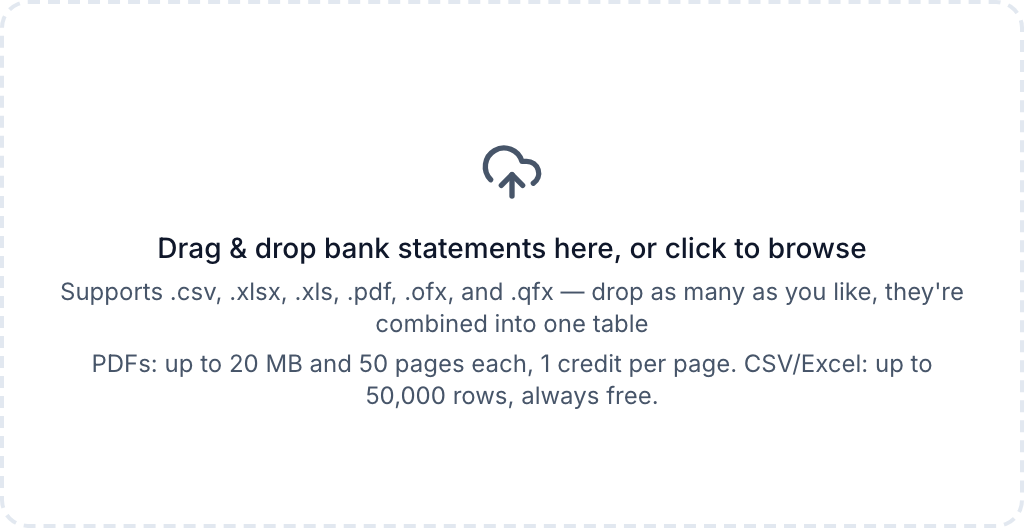
Drop in every statement
PDFs, scans, CSV and Excel exports, several at once, combined into one table.

Checked against its own totals
Every file says whether its rows add up to the balances it prints.
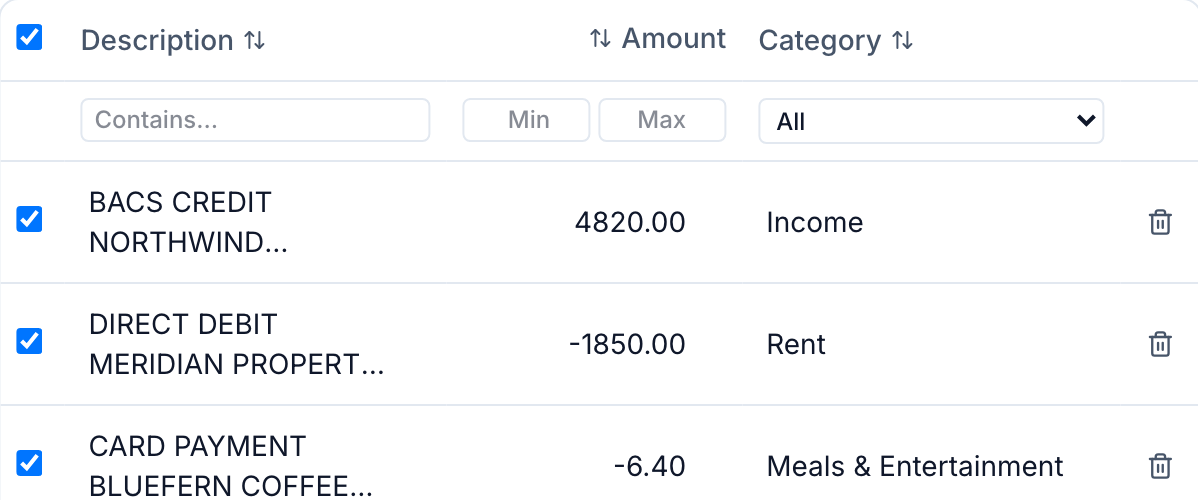
Every row, categorized
Rule-based categories on every transaction, and any cell editable before export.
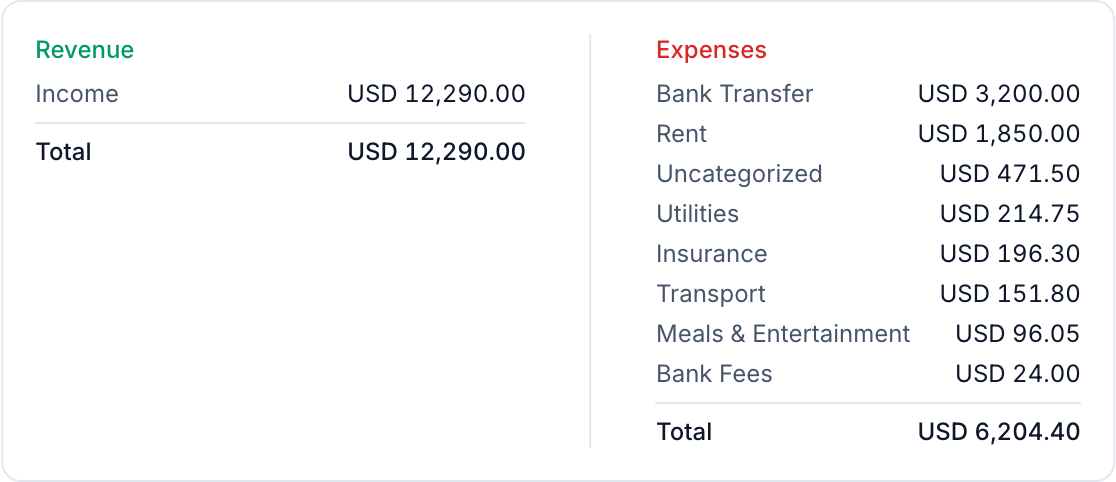
Revenue and expenses at a glance
Totals by category for exactly the rows you're about to export.

Your own rules
Teach it a phrase once, like STATIONERY to Office Expenses, and every statement after follows it.

Export where it's going
CSV and Excel on every plan; QuickBooks .QBO and Xero on Pro and Firm.
Your statement, handled like a statement
No AI reads it
Fixed rules and arithmetic, not a language model. The same statement gives the same rows every time.
Nothing is kept
The PDF is read in memory and discarded once the rows are out. CSV and Excel files never leave your browser.
Passwords are used once
A statement's password opens it in memory for that one upload, and is never saved or logged.
Common questions
- What does the badge on each file mean — "Matches statement totals", "Doesn't match statement", or "Verify against the statement"?
- After extraction, we check whether the rows we found add up to what your statement says about itself — its opening and closing balance, its own column totals, or the running balance printed beside each row. "Matches statement totals" means they do, to the cent. The running balance is the most useful of the three when a file has one, because it is checked at every row rather than once at the end, so it can tell you which row something goes wrong at — and it catches a case the totals cannot: a file that is missing transactions whose amounts happen to cancel out. "Doesn't match statement" means they don't, and we show you exactly which figures disagree. "Verify against the statement" means your statement didn't print anything we could check against — no balances, no totals, no running balance — so we're telling you to eyeball it yourself rather than pretending it's fine. It's a common enough outcome that we publish the actual rate across our own test corpus on the benchmark page rather than asking you to take a number on trust. None of this is the same as an accountant reconciling your account against an independent record; it only checks that what we extracted is internally consistent with what your own statement says. Edit an amount or delete a row afterward and we re-run the same check automatically, so the badge always reflects what you're about to export — and because that recheck runs entirely in your browser, fixing a flagged row never sends anything back to our servers or creates a new copy of your data there.
- Can I upload a password-protected PDF?
- Yes. Many banks lock e-statements with a password. Upload the file as usual and its card will ask for the password; type it there and choose Open. The password goes with that one upload, is used to open the file in memory, and isn't saved, logged or sent anywhere else. A wrong password costs nothing: credits are only used once a file has opened and been read.
- How accurate is the extracted data?
- PDF extraction uses each page's real text layer where available, with OCR as a fallback for scanned statements. CSV columns are auto-mapped to Date/Description/Amount from common header names — or, when a file's headers say nothing useful (some bank exports really do label their columns "Column 1" to "Column 7"), from the data itself. Both are best-effort: bank statement formats vary too much to guarantee perfect extraction, which is why every upload lands in an editable table where you can adjust the column mapping and deselect or delete any row before exporting. We also check our own work: after extraction, we compare the rows we found against the totals your statement prints about itself, and show you the result as a badge next to the file rather than asking you to just trust the table.
Try it on your own Metro Bank statement
50 free PDF credits, no card required. CSV and Excel exports are free on every plan.